Clay County Dog Registration Information
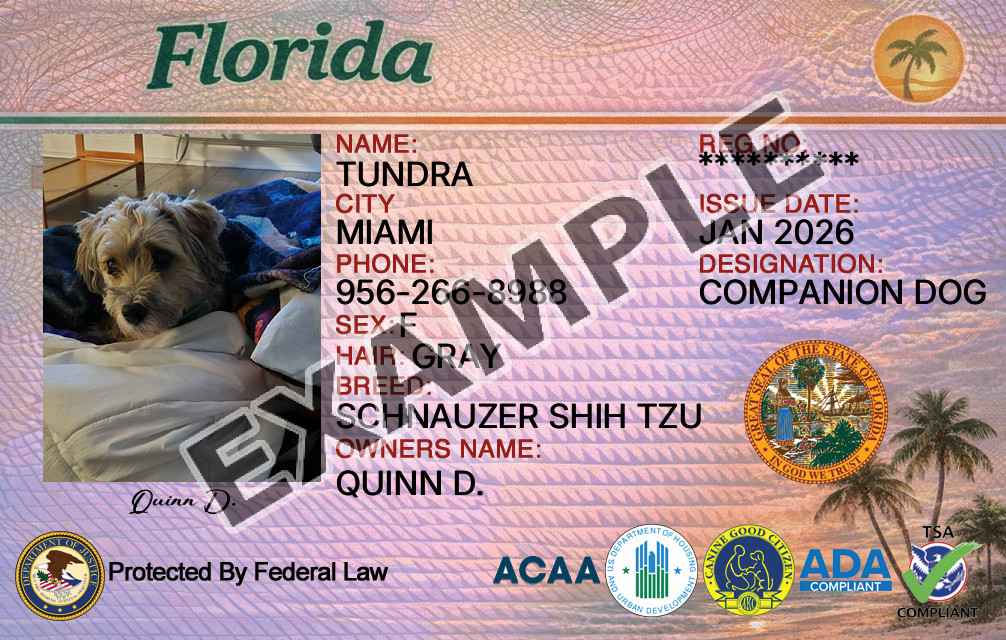
Service Dogs and Emotional Support Animals in Clay, Florida
If you’re searching where do I register my dog in Clay County, Florida for my service dog or emotional support dog, the answer usually involves two separate ideas: (1) local dog licensing (often tied to a current rabies vaccination) and (2) your dog’s service dog or emotional support animal (ESA) status, which is governed by different laws and is not handled through one universal federal registration. This page explains how dog licensing works locally, what to bring, and which official Clay County office typically handles animal services questions.
- A dog license in Clay County, Florida (when required) is a local compliance item—often related to rabies vaccination proof and identification of the owner/animal.
- Service dogs are defined by federal law based on training to perform tasks for a person with a disability; they are not “made official” by buying a registry ID.
- Emotional support animals can be recognized for certain housing situations with appropriate documentation, but they are not service animals for public-access purposes.
Where to Register or License Your Dog in Clay County, Florida
The primary official office for animal services questions (including guidance on local requirements, rabies-related compliance, and enforcement issues) is Clay County Animal Services. If you are unsure whether you need a county dog license (or whether your city has additional rules), starting with Animal Services is the most direct path.
Clay County Animal Services (Clay County, Florida)
- Explains county animal ordinances and compliance steps for Clay County residents
- Guidance on rabies vaccination documentation and animal identification
- Direction on what to do if you live inside an incorporated city and need to confirm any city-specific rules
- Assistance for enforcement-related questions (for example, loose dogs, bite incidents, nuisance complaints)
Overview of Dog Licensing in Clay County, Florida
What “dog registration” usually means locally
In everyday terms, “registering a dog” in many Florida counties refers to obtaining or renewing a dog license (sometimes called a county tag) and keeping your dog’s rabies vaccination current. Requirements can be set by county ordinance and may be enforced by animal control/animal services.
Rabies vaccination is commonly tied to licensing
Most local licensing systems depend on proof that your dog is currently vaccinated against rabies. Your veterinarian typically issues a rabies certificate at the time of vaccination, and the certificate details (including date administered and expiration) are commonly what the county needs to confirm compliance.
Service dog or ESA status does not replace local licensing
If your dog is a service dog or an emotional support animal, you may still be expected to follow local animal rules such as rabies vaccination, leash laws, and any applicable dog licensing requirements in Clay County, Florida. These local requirements are separate from disability and housing laws.
What You Need Before Registering a Dog
Common documents and information to gather
Exact requirements can vary depending on where you live in the county and the type of transaction (new license vs. renewal). However, these items are commonly requested when dealing with animal control dog license Clay County, Florida questions and similar licensing processes:
- Proof of current rabies vaccination (rabies certificate from your veterinarian)
- Owner identification (such as a driver license or other ID)
- Proof of residency (if required for county-only services or fees)
- Dog description (name, breed, color/markings, sex, approximate age)
- Spay/neuter documentation (if the fee structure or your situation depends on it)
If your dog is a service dog or ESA
For local licensing, service dog or ESA status usually does not change the basic documentation (rabies certificate, ownership info). For housing or employment-related accommodations, separate documentation rules may apply (explained below). If you are unsure what applies to your situation, start with Clay County Animal Services for local licensing questions, and consider speaking with your healthcare provider for ESA documentation needs.
Steps to Register or License a Dog in Clay County, Florida
Step 1: Confirm which rules apply to your address
When people ask where to register a dog in Clay County, Florida, the first step is confirming whether your location is in unincorporated Clay County or within an incorporated city, and whether there are any city-specific requirements layered on top of county rules. If you are not sure, contact Clay County Animal Services using the office block above.
Step 2: Make sure rabies vaccination is current
Schedule rabies vaccination (or a booster) with your veterinarian if needed and keep the rabies certificate. If you are looking for county-run services, Clay County Animal Services also notes that it offers periodic rabies vaccination opportunities for eligible residents.
Step 3: Ask how the county issues licenses/tags (new vs. renewal)
Depending on how Clay County administers licensing for your situation, you may need to provide a rabies certificate and pay a fee. Ask:
- Whether the county issues a physical tag and what the turnaround time is
- Whether you can complete the process in person during public hours
- What fees apply and what payment methods are accepted
- What to do if you recently moved to Clay County or adopted a dog
Step 4: Keep your documentation accessible
Keep copies (paper or digital photos) of rabies vaccination records and any county-issued license documentation. This can be helpful if your dog becomes lost, if there is an animal services inquiry, or if you need to show compliance quickly.
Service Dog Laws in Clay County, Florida
Service dog definition (public access)
A service dog is generally understood (under federal disability law) as a dog individually trained to do work or perform tasks for a person with a disability. The dog’s legal status comes from training and function, not from a purchased “registration.”
No single “federal service dog registry” for public access
There is no one universal federal government registry you must use to make a dog a service dog for public access. Locally, you typically do not “register your service dog” with the county as a way to create service dog rights. Instead:
- Public access generally depends on whether the dog is trained to perform disability-related tasks.
- Local licensing (if applicable) is still about public health and identification (like rabies compliance), not about granting service dog status.
Local rules still apply (leash laws, vaccines, nuisance rules)
Service dogs are generally expected to follow the same local public health and safety rules as other dogs (for example, being under control, meeting rabies vaccination expectations, and following any applicable county or city ordinances). If you want the most accurate guidance for your address, contact Clay County Animal Services.
Emotional Support Animal Rules in Clay County, Florida
What an emotional support animal is (and is not)
An emotional support animal (ESA) is an animal that provides comfort to a person, typically connected to a mental or emotional health condition. ESAs are not the same as service dogs because they are not defined by task training for a disability in the same way a service dog is.
Housing is the most common ESA context
ESA requests most commonly come up in housing situations, where a resident may request a reasonable accommodation. In that context, housing providers may require reliable documentation consistent with applicable law and guidance.
ESA status does not change local licensing requirements
Even if your dog is an ESA, local requirements—such as rabies vaccination and any applicable dog licensing requirements Clay County, Florida—are separate from ESA housing accommodations. If you’re trying to figure out what the county expects for “registration,” start with Clay County Animal Services and ask specifically about dog licensing for your residence address.
Dog License vs. Service Dog vs. Emotional Support Animal (ESA)
| Category | Dog License (Local) | Service Dog | Emotional Support Animal (ESA) |
|---|---|---|---|
| Primary purpose | Local public health, identification, and compliance (often tied to rabies vaccination). | Assists a person with a disability by performing trained tasks/work. | Provides comfort/support that may help with a disability-related need (commonly in housing contexts). |
| Who manages it | County/city animal services or other local government office (varies by jurisdiction). | Defined by federal disability law; status is based on training and function, not a county registration. | Often addressed through housing accommodation processes; not a public-access category like service dogs. |
| Typical documentation | Rabies vaccination certificate; owner and pet information; possible proof of residency. | No universal federal registration required; practical documentation may include training records, but legal status is not created by an online registry. | Housing-related documentation may be requested; local licensing items (like rabies) still apply. |
| Public access rights | No. | Yes, when criteria are met under applicable law. | No (ESA status does not provide the same public-access rights as a service dog). |
| Does it replace local licensing? | Not applicable. | No—service dogs generally still need to follow local animal rules (vaccines, control, etc.). | No—ESA status generally does not replace local animal rules. |
Tip: If your main goal is “official registration” for a service dog or ESA, start by separating the question into (1) dog license in Clay County, Florida (local compliance) and (2) service dog or ESA documentation for the specific setting (public access vs. housing).
Frequently Asked Questions
Register A Dog In Other Florida Counties
Select your county below to get started with your dog’s ID card. Requirements and license designs may vary by county, so choose your location to see the correct options and complete your pup’s registration.
- Alachua Dog License Cards
- Baker Dog License Cards
- Bay Dog License Cards
- Bradford Dog License Cards
- Brevard Dog License Cards
- Broward Dog License Cards
- Calhoun Dog License Cards
- Charlotte Dog License Cards
- Citrus Dog License Cards
- City of Jacksonville Dog License Cards
- Collier Dog License Cards
- Columbia Dog License Cards
- DeSoto Dog License Cards
- Dixie Dog License Cards
- Duval Dog License Cards
- Escambia Dog License Cards
- Flagler Dog License Cards
- Franklin Dog License Cards
- Gadsden Dog License Cards
- Gilchrist Dog License Cards
- Glades Dog License Cards
- Gulf Dog License Cards
- Hamilton Dog License Cards
- Hardee Dog License Cards
- Hendry Dog License Cards
- Hernando Dog License Cards
- Highlands Dog License Cards
- Hillsborough Dog License Cards
- Holmes Dog License Cards
- Indian River Dog License Cards
- Jackson Dog License Cards
- Jefferson Dog License Cards
- Lafayette Dog License Cards
- Lake Dog License Cards
- Lee Dog License Cards
- Leon Dog License Cards
- Levy Dog License Cards
- Liberty Dog License Cards
- Madison Dog License Cards
- Manatee Dog License Cards
- Marion Dog License Cards
- Martin Dog License Cards
- Miami-Dade Dog License Cards
- Monroe Dog License Cards
- Nassau Dog License Cards
- Okaloosa Dog License Cards
- Okeechobee Dog License Cards
- Orange Dog License Cards
- Osecola Dog License Cards
- Palm Beach Dog License Cards
- Pasco Dog License Cards
- Pinellas Dog License Cards
- Polk Dog License Cards
- Putnam Dog License Cards
- Santa Rosa Dog License Cards
- Sarasota Dog License Cards
- Seminole Dog License Cards
- St. Johns Dog License Cards
- St. Lucie Dog License Cards
- Sumter Dog License Cards
- Suwannee Dog License Cards
- Taylor Dog License Cards
- Union Dog License Cards
- Volusia Dog License Cards
- Wakulla Dog License Cards
- Walton Dog License Cards
- Washington Dog License Cards
